
A tube mill scarfing tool system removes the weld bead that the HF welder leaves on the inside and outside of the seam. Outside, it is a finish question. Inside, it is a function question: a raised internal bead restricts flow, catches product in food and sanitary tube, and will not pass a drift or pig test. It also gives the cutter something to hit on the next operation.
Two knives, one pass line
Internal and external scarfing are separate tools but one setting. The internal knife runs on a rod inside the tube; the external knife sits in a holder outside. Both are set relative to the same pass line, so the bead is removed flush in a single pass rather than in two operations with the tube handled in between.
| Internal scarfing | External scarfing | |
|---|---|---|
| What it removes | The weld bead inside the tube | The weld bead on the outside |
| Why | Flow, drift test, coating, downstream forming | Appearance, coating, printing, galvanising |
| Tool position | On a rod inside the tube, behind the weld station | In a holder above or beside the tube |
| Typical failure | Rod whip, knife chatter on thin wall | Holder deflection, knife digging on start-up |
How the internal tool is carried
The internal knife has to reach the weld point from outside the tube. Three arrangements cover most mills:
- Pull rod — a rod runs through the formed tube from the entry end and pulls the knife head. Used on smaller mills and shorter runs.
- Cantilever rod — the rod is supported at the entry side only. Simple, but rod deflection grows with length and diameter.
- Roller-supported rod — guide rollers inside the tube support the rod near the knife. Standard on large mills, because a 6 m unsupported rod will whip.
Rod whip is the root cause of most internal scarfing complaints. When the knife chatters, the bead comes out with a torn edge and the tube shows a wave along the seam. Adding knife pressure does not fix it; supporting the rod does.
Knife geometry and material
The knife is a small, hard, disposable part. What matters:
- Rake and clearance set to the wall thickness. A knife set for 3 mm wall will dig on 1 mm wall.
- Carbide grade matched to tube material. Mild steel and galvanised tube do not need the same grade as stainless.
- Clamping — a knife that can move in its holder will chip, and the chip marks the tube for metres.
- Setting gauge — a knife set by eye leaves a step, and a step is a stress riser in every pressure application.
We supply knives, holders, rods and the setting gauges as one set, because a knife that does not match its holder is a knife that will chip.
What a good internal scarf looks like
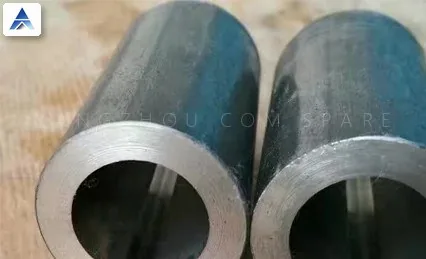
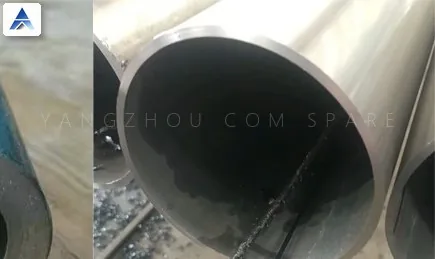
The photographs below are from mills running our tooling. On the left, two tube ends with the internal bead removed flush — the wall reads continuous, with no step at the seam. On the right, the inside of a tube before scarfing for comparison: the raised bead is visible along the seam.
Why a scarf sometimes fails
| Symptom | Usual cause |
|---|---|
| Bead still visible, or a thin fin left | Knife set too shallow, or worn |
| Groove or step in the wall | Knife set too deep, or holder deflecting |
| Chatter marks along the seam | Rod whip, loose knife clamp, or mill vibration |
| Knife chipping early | Wrong clearance for the wall, or mill scale in the seam |
| Scarf works at low speed, not at high | Rod support or knife pressure not sized for the speed |
Note that three of those five are setting or support problems, not knife quality. A new knife on a badly supported rod performs worse than a worn knife on a good one.
What we need to quote a scarfing set
- Tube outside diameter and wall range
- Mill model and the distance from the weld station to the scarfing position
- Whether the internal tool is pulled from the entry end or supported inside the tube
- Tube material and whether the inside will be coated or lined later
- Line speed range
With those, we quote the complete set: internal knife and rod, external knife and holder, setting gauge, and a spare knife. Individual knives and holders are also available as replacements.
Related products
Tube mill spare parts · Shearing and welding machine · ERW tube mill line · Tube mill rolls.

