
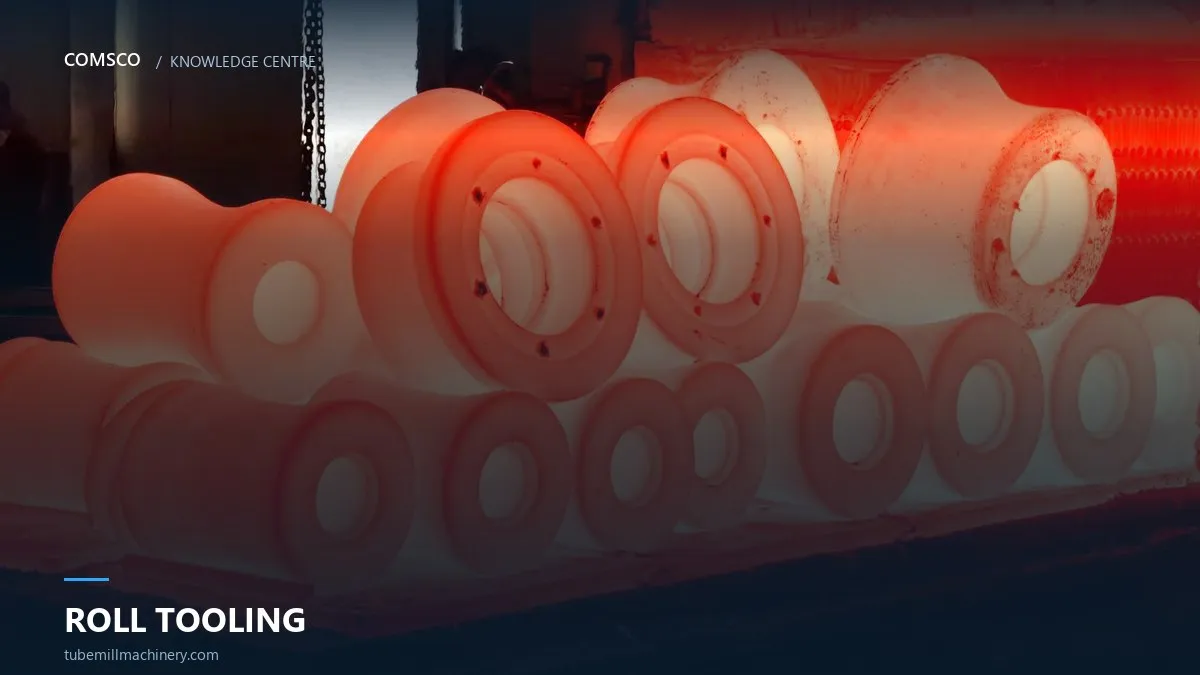
When a roll set fails early, the conversation usually goes to hardness. “It was supposed to be 60 HRC.” Hardness is the easiest number to quote and one of the least useful on its own. Two rolls at 60 HRC can behave completely differently depending on the steel, the heat treatment and how evenly that hardness is distributed.
What a roll actually has to survive
- Abrasion from strip sliding under pressure — wear on the groove surface.
- Contact fatigue from millions of revolutions under load — pitting and spalling.
- Impact at the strip entry and at weld joints — chipping of edges and flanges.
- Thermal cycles near the weld zone, where the roll sees heat from the tube.
No single steel optimises all four. Roll design is choosing the compromise that matches your product.
The common grades and where they fit
| Grade | Character | Best for | Watch out for |
|---|---|---|---|
| Cr12MoV (D2 family) | High carbon, high chromium; very good wear resistance | Forming and sizing rolls on carbon steel, high-volume work | Lower toughness; can chip if heat treatment is too hard |
| D2 / SKD11 equivalent | Similar to Cr12MoV with regional variation | General forming rolls | Quality varies widely between suppliers; ask for the certificate |
| GCr15 (52100) | Bearing steel; good toughness with decent wear resistance | General purpose rolls, guide rolls, shafts | Softer at high temper; not ideal for abrasive scale |
| H13 (4Cr5MoSiV1) | Hot-work steel; retains hardness at temperature | Rolls close to the weld, high thermal load | Lower wear resistance than D2 at room temperature |
| Carbide (solid / insert) | Extreme wear resistance | Very high volume, abrasive material | Brittle, expensive, needs rigid stands |
Heat treatment: the part nobody inspects
A roll is not “hardened” as a single act. It is rough machined, heat treated, then finish ground. Three details decide the result:
- Hardening temperature and soak. Too low and the alloy carbides do not dissolve; too high and the grain grows, making the steel brittle.
- Quench and temper. The tempering temperature sets the final hardness and relieves stress. A roll that is quenched hard and barely tempered will be hard and cracked.
- Grinding after treatment. Grinding removes the decarburised skin, but it can also introduce grinding burn if the wheel is too aggressive — a soft, tempered patch that wears first and shows as a shiny band.
This is why a hardness certificate taken at the surface is not proof of quality. Ask for hardness at the working surface and at two depths, and for the heat treatment record.
Uniformity beats headline hardness
A roll that measures 60 HRC at one point and 55 HRC at another will wear unevenly. The groove loses its profile on one side, the tube develops a corresponding shape error, and the roll is scrapped before its “expected” life. In practice, ±1.5 HRC across the working surface is a reasonable production target, and ±1 HRC is what a good toolroom achieves.
For deep-hardened rolls, the hardened layer also needs enough depth to survive regrinding. A shallow case hardens beautifully and disappears at the first resharpen.
Cryogenic and coating treatments
Deep cold treatment after quenching converts retained austenite and improves dimensional stability — useful for precision rolls that must hold profile over many regrinds. Surface coatings (PVD, nitriding) can reduce friction and galling, particularly on stainless or galvanised work where material transfer marks the tube. Both are worth considering when the failure mode is surface adhesion rather than abrasion.
A practical specification
- Steel grade stated with certificate, not just “tool steel”.
- Hardness range with tolerance, measured on the working surface and at depth.
- Hardened depth sufficient for the number of regrinds expected.
- Stress relief after rough machining, before finish machining.
- Profile tolerance and surface finish stated on the drawing.
- Traceability: heat number marked on the roll.
If your rolls are failing in a way that does not match abrasion — chipping, cracking, or a shiny band that wears first — send us photographs and the failure position. In most cases the answer is visible in the failure mode, not in the hardness number.
See our roll tooling range for materials and treatments we run in-house, or the roll set page for how sets are matched to a mill.
Frequently asked questions
What hardness should tube mill rolls be?
Most forming and sizing rolls in tool steel run in the 58–62 HRC range. More important than the headline figure is uniformity across the working surface, typically within ±1.5 HRC, and enough hardened depth to allow regrinding.
Is Cr12MoV the same as D2?
They are closely related high-carbon, high-chromium tool steels and are often treated as equivalents, but the exact composition and quality vary by mill. For critical tooling, specify the grade with a material certificate rather than relying on the trade name.
Why do my rolls chip instead of wearing out?
Chipping points to impact or brittleness: hardness set too high, insufficient tempering, a sharp internal corner in the profile, or strip entering the stand misaligned. Check the failure position before changing material.
Keep reading

Tube Mill Roll Changeover: Where the Hours Actually Go
Ask a mill manager how long a size change takes and the answer is usually a number with a shrug:…

Reading Roll Wear: Resharpen, Recoat or Replace?
Every roll set reaches a point where the decision is no longer technical but economic. Four measurements tell you whether…
Tube Mill Roll Design: From Flower Pattern to the First Good Tube
Roll design is not a drawing exercise. It is a sequence of decisions about strip width, bend distribution and edge…
Related Products
Machines that do the job described above — quoted station by station.
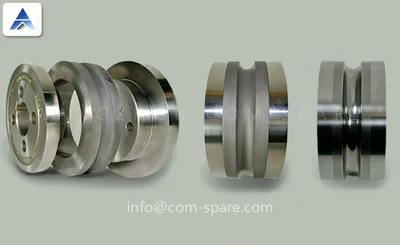 ProductTube Mill Rolls & Roll ToolingPass design, machining and vacuum hardening in-house.View specifications →
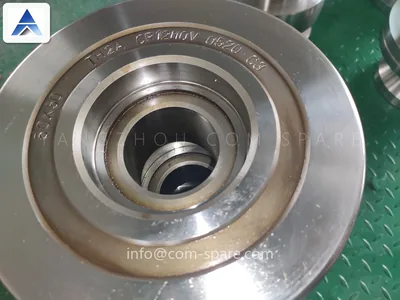 ProductTube Mill RollsFinished passes, ground after hardening.View specifications →
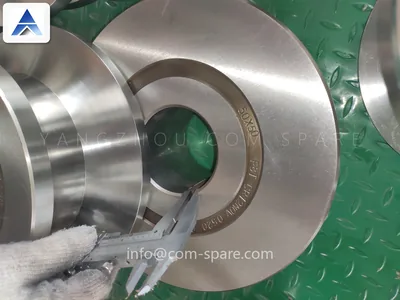 ProductTube Mill MouldForming and sizing moulds to your flower pattern.View specifications →
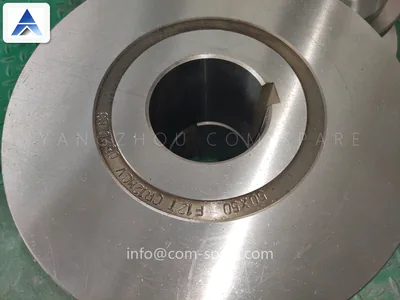 ProductTube Mill Roll SetA complete pass line, numbered and pre-set.View specifications →
 ProductTube Mill Roll DesignFrom flower pattern to finished pass drawing.View specifications →
Need this checked on your own mill?
Send tube OD, wall thickness and the symptom. We reply within one working day.

