
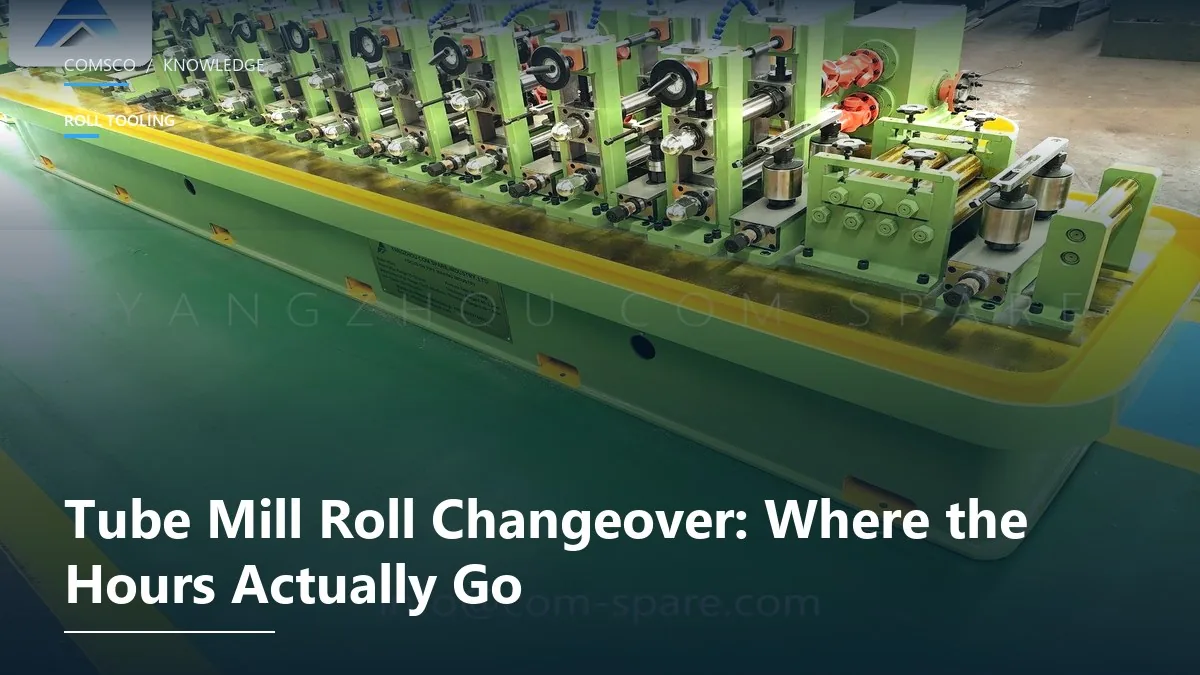
Ask a mill manager how long a size change takes and the answer is usually a number with a shrug: “about a shift, if it goes well.” Break the change down and the hours are rarely in the part everyone blames. Lifting rolls out of stands is fast. What takes the time is everything either side of it — and most of that is decided before the change starts.
Five actions, not one
A roll changeover is five separate jobs stacked in sequence. Treating them as one lump is why the time never comes down.
| Stage | What happens | Who decides the duration |
|---|---|---|
| 1. Strip out and stop | Run the coil to the end, cut, clear the mill of strip | Coil length and the operator’s timing |
| 2. Roll out | Open stands, withdraw shafts, lift the old set out | Stand design and crane access |
| 3. Roll in | Fit the new set, correct stand by stand to the pass line | Whether the set was pre-assembled |
| 4. Set and check | Pass line height, shaft parallelism, roll gap, fin gap | Tooling and measuring discipline |
| 5. First tube | Thread, weld, adjust to size, cut a sample | How much the set was trusted |
In a typical change on a 76 mm mill, stages 1 and 2 together take less than a quarter of the elapsed time. Stage 5 — the first tube — often takes as long as everything else combined, because the mill is being adjusted to compensate for something that was wrong in stage 4.
Quick-change cassettes: what they really buy
A cassette holds a complete stand’s roll set with its shafts and bearings, pre-set to the pass line. The change becomes a swap rather than a rebuild: lift the old cassette out, slide the new one in, lock it.
What it buys is not speed of lifting. It buys the ability to do stages 3 and 4 before the mill stops, on a bench, with the light and the measuring tools you want. The changeover becomes a handling task instead of a precision task.
Two conditions have to be true for that to work:
- The cassette locates on a repeatable datum, not on a shim stack that has to be re-measured every time.
- Each cassette is numbered and its pass line height is recorded, so the fitter knows what he is fitting before he starts.
Without both, a cassette is just a heavier way to change rolls.
The three measurements that cause most of the rework
When a new set runs badly and the rolls are correct, the fault is nearly always one of these:
| Measurement | What goes wrong | What you see |
|---|---|---|
| Pass line height | One stand set high or low by a millimetre | Strip lifts or dives; the tube shows a wave at one point along its length |
| Shaft parallelism | Top shaft not parallel to bottom | Tube oval in one direction, or a taper along the length |
| Fin gap | Too wide, or unevenly set | Weld not closed, or the edges overlap and the weld bead grows |
All three are checkable with a straight edge, a feeler gauge and a dial indicator, and none of them is checkable by eye. A mill that measures these three at every change spends less time on first tube than a mill that does not.
Pre-setting the set on the bench
The single biggest saving in a changeover comes from moving work off the mill. On the bench you can:
- Assemble each stand’s rolls on its shaft, with the correct spacers and keys.
- Set the nominal roll gap with a feeler gauge, and record it.
- Check that each roll turns freely and that the flange faces are clean.
- Confirm the numbering matches the pass line drawing, stand by stand.
None of that needs the mill to be stopped, and all of it is easier with the stand at waist height. A set that arrives at the mill already assembled and checked turns a six-hour change into a three-hour one on the same machine.
The first tube is a test, not a tuning session
A first tube that needs twenty minutes of adjustment is telling you the changeover was not finished. Work through it in a fixed order, because the order separates causes from symptoms:
- Outside diameter. If OD is wrong at the sizing stands, stop there. Nothing downstream is meaningful.
- Ovality. Oval means parallelism or a sizing pass set wrong — not a weld problem.
- Weld quality. Check the seam only once the geometry is right. A gap caused by bad forming looks exactly like a power problem.
- Cut length and burr. Last, because the saw is independent of everything before it.
Working in that order means the first tube takes one pass, not five. Working in the opposite order — starting at the welder because the weld looks wrong — means chasing a forming problem through the power setting.
A realistic time budget
| Mill size | Change with pre-set cassettes | Change with loose rolls |
|---|---|---|
| ø16 – ø50 mm, 10–14 stands | 1.5 – 2.5 h | 3 – 5 h |
| ø32 – ø76 mm, 12–16 stands | 2 – 3.5 h | 4 – 7 h |
| ø76 – ø165 mm, 16–20 stands | 3 – 5 h | 6 – 10 h |
Those numbers assume a crane that reaches every stand, a bench beside the mill, and a set that was checked before the change started. Take any of the three away and the loose-roll column becomes optimistic.
What to ask a tooling supplier
If changeover time matters to your order book — and on short-run work it is usually the constraint — ask for more than a price per set:
- Are the rolls marked with stand and pass number, permanently?
- Is the set supplied with a pass list and the nominal gaps recorded?
- Can the set be supplied already assembled on shafts or in cassettes?
- Is the profile drawing kept on file, so the next set is identical?
The last one matters more than it sounds. A second set that is 0.05 mm different in the fin pass will not run on the same mill setting as the first, and the changeover time you saved on the tooling goes straight back into the first tube.
Roll design and pass sequencing are covered in Tube mill roll design: from flower pattern to the first good tube. How rolls wear and when to replace them is in Reading roll wear: resharpen, recoat or replace?
Keep reading
Reading Roll Wear: Resharpen, Recoat or Replace?
Every roll set reaches a point where the decision is no longer technical but economic. Four measurements tell you whether…
Roll Material and Heat Treatment: D2, Cr12MoV, GCr15 and What Actually Lasts
Two roll sets can look identical and last very differently. The difference is in the steel grade, the heat treatment…
Tube Mill Roll Design: From Flower Pattern to the First Good Tube
Roll design is not a drawing exercise. It is a sequence of decisions about strip width, bend distribution and edge…
Related Products
Machines that do the job described above — quoted station by station.
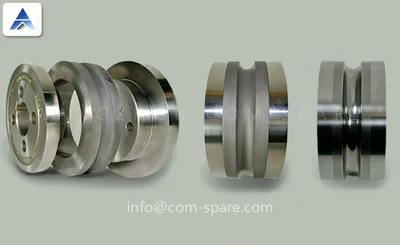 ProductTube Mill Rolls & Roll ToolingPass design, machining and vacuum hardening in-house.View specifications →
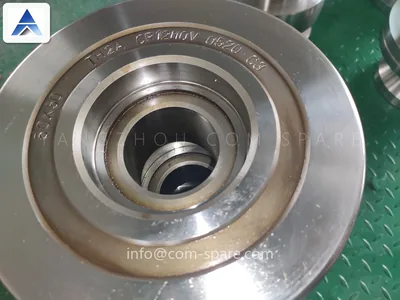 ProductTube Mill RollsFinished passes, ground after hardening.View specifications →
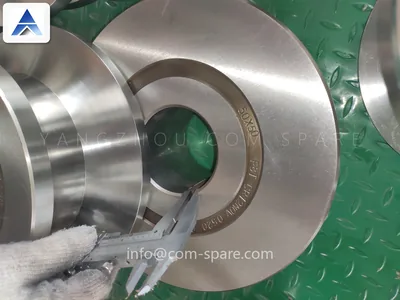 ProductTube Mill MouldForming and sizing moulds to your flower pattern.View specifications →
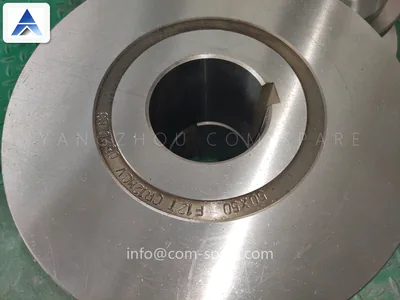 ProductTube Mill Roll SetA complete pass line, numbered and pre-set.View specifications →
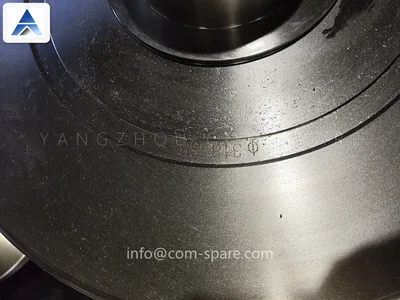 ProductTube Mill Roll DesignFrom flower pattern to finished pass drawing.View specifications →
Need this checked on your own mill?
Send tube OD, wall thickness and the symptom. We reply within one working day.

