
When a weld fails, the welder gets the attention. But the two edges being welded were prepared by a slitting line, possibly weeks earlier and hundreds of kilometres away. If those edges are burred, hardened or not parallel, no welding parameter will produce a consistent seam.
What “good edge” means
A slit edge suitable for ERW tube has four properties:
- Straightness. The edge follows the strip direction without camber (a curve along the coil).
- Squareness. The cut face is close to perpendicular to the strip surface, without a heavy roll-over.
- Burr height. Small and consistent. A large burr holds the edges apart at the weld point and produces a notch.
- Width tolerance. Consistent along the coil and between coils.
Burr: small number, large effect
A burr is a ridge of displaced metal on one face of the slit edge. At the weld point, the burr sits between the two edges and prevents full contact. The welder compensates by increasing power, the bead grows, and the seam looks acceptable — until the tube is expanded, bent or pressure tested and the joint opens along the burr line.
The practical control is burr height relative to strip thickness. For thin strip, even a small burr is a significant fraction of the wall. Ask your slitter what burr height they hold and how they measure it; many cannot answer with a number.
Camber and the spiral it causes
Camber is a curvature of the strip along its length. Feed a cambered strip into a tube mill and one edge is effectively longer than the other. The strip tries to spiral as it is formed, the weld wanders to one side, and the operator corrects with guide rolls — which loads the strip asymmetrically and produces a second problem.
If a mill welds straight for part of a coil and then starts wandering, check the coil’s camber before touching the mill. A straight edge laid along the strip on the uncoiler tells you in a minute.
Edge hardening
Shearing work-hardens the edge. A dull slitter blade or an incorrect clearance produces a larger hardened zone and micro-cracks at the edge. At the weld, the hardened edge behaves differently from the parent strip: it needs different heat and different forging pressure. The result is a weld that looks fine on the outside and is brittle in the heat-affected zone.
This is one reason to know your slitter’s blade condition, not just their price. Cheap slitting with worn tooling produces strip that costs more per tonne of good tube.
Width tolerance and the weld gap
The strip width sets how much material arrives at the weld point. A coil that runs 1 mm wide through its length forces the mill to absorb the excess: a heavier bead, a slight OD increase, or edge wave. A coil that runs narrow produces a gap and a weak weld.
For most tube sizes, a width tolerance of ±0.5 mm is workable and ±0.2 mm is comfortable. If your supplier quotes ±1 mm, ask what that does to the weld gap at your smallest wall thickness.
A receiving check that takes ten minutes
| Check | Method | Accept |
|---|---|---|
| Width | Tape or caliper at head, middle and tail | Within agreed tolerance, consistent |
| Camber | Straight edge along 2 m of strip on the uncoiler | Small, visible gap |
| Burr | Finger test and visual on both edges | No sharp ridge, no rolled-over edge |
| Edge cracks | Visual at 5× on the coil end | None |
| Coil shape | Visual — telescope, dish, edge damage | No deformation that affects feeding |
Recording these at goods-in gives you something to show a supplier when a weld problem appears three weeks later. Without it, the conversation is opinion against opinion.
Where the mill can compensate, and where it cannot
A tube mill can tolerate small width variation through the forming and sizing sections. It cannot fix camber, cannot absorb a heavy burr, and cannot make a weld out of edges that are not parallel. Knowing which problems belong to the mill and which belong to the strip is the difference between fixing a defect and chasing it.
Our tube mill spare parts range includes guide rolls and entry section components that help a mill handle imperfect strip, and the tube mill line page describes the entry configuration.
Frequently asked questions
What burr height is acceptable on slit strip for ERW tube?
It depends on wall thickness, but burr should be a small fraction of the strip thickness and consistent along the coil. A burr that can be felt as a sharp ridge is already large enough to affect weld contact.
Can strip camber cause a weld to wander?
Yes. Camber makes one edge effectively longer, so the strip spirals as it forms and the weld moves to one side. Check camber on the uncoiler before adjusting the mill.
Does strip width tolerance affect tube quality?
It does. Width variation changes how much material arrives at the weld point, which shows up as bead variation, OD drift or edge wave. ±0.5 mm is workable for most sizes; tighter is better for thin wall.
Keep reading
ERW Weld Seam Defects: A Diagnostic Order That Saves Time
A tube mill with a weld problem usually gets adjusted in the order the symptoms appear, and the symptoms appear…
Accumulator Sizing: How Many Seconds of Strip Your Line Really Needs
An undersized accumulator turns every coil change into a mill stop. Here is the calculation, the three accumulator types, and…
Shear & End Welder: The Coil Joint That Decides Your Weld Seam
The joint made at the entry section passes through every forming stand and arrives at the weld point. If defects…
Related Products
Machines that do the job described above — quoted station by station.
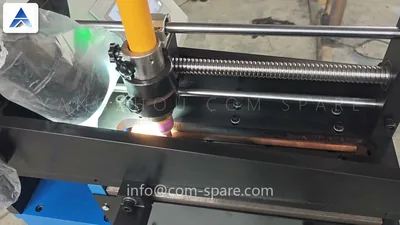 ProductShearing & Welding MachineA coil joint that survives every forming stand.View specifications →
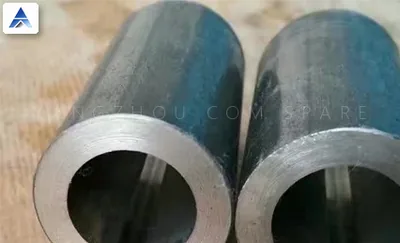 ProductTube Mill Scarfing Tool SystemInternal and external bead removed flush.View specifications →
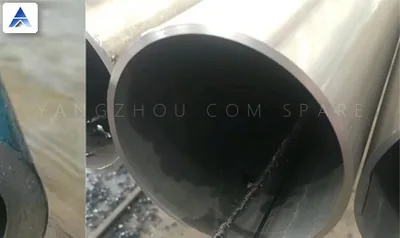 ProductTube Mill Spare PartsImpeders, knives, blades and guide rolls.View specifications →
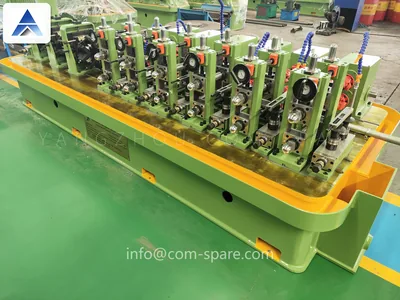 ProductAutopacking MachineCount, stack and strap finished tubes.View specifications →
Need this checked on your own mill?
Send tube OD, wall thickness and the symptom. We reply within one working day.

