
The accumulator is the least visible machine on a tube mill and the one that decides whether the mill is genuinely continuous. When it is right, nobody notices it. When it is undersized, every coil change becomes a small stoppage, and the first metres of tube after each restart carry a different thermal history from the rest.
What the accumulator is for
During a coil change, the entry section must stop: the strip is clamped, sheared and welded. The forming and welding sections cannot stop, because stopping and restarting changes weld temperature and produces scrap. The accumulator stores strip so the mill keeps running while the entry is stationary.
The requirement is simple to state: stored strip must last longer than the complete coil-change cycle, with margin.
The calculation
Storage time needed (seconds) = coil-change cycle time + safety margin.
Coil-change cycle time includes: deceleration, clamping and centring, shearing, alignment, welding, bead treatment, release and re-acceleration. On a well-set automatic machine this is typically 40–90 seconds. Manual or semi-automatic machines can take two to three minutes.
Then convert to strip length:
Stored length (m) = line speed (m/min) ÷ 60 × storage time (s)
For example: 60 m/min line speed and a 90-second cycle needs 90 m of stored strip. Add 20–30% margin for operator reaction and slower cycles, and the accumulator must hold around 110–120 m.
| Line speed | Cycle 60 s | Cycle 90 s | Cycle 120 s |
|---|---|---|---|
| 30 m/min | 30 m | 45 m | 60 m |
| 60 m/min | 60 m | 90 m | 120 m |
| 90 m/min | 90 m | 135 m | 180 m |
| 120 m/min | 120 m | 180 m | 240 m |
These are minimums before margin. This is why a high-speed line cannot use the same accumulator as a low-speed line with the same tube size — the machine is the same, the requirement is double.
Three types, three trade-offs
Horizontal spiral accumulator
Strip is stored in horizontal loops on a spiral drum. Large capacity, stable strip feeding, needs floor space. The standard choice for medium and high-speed lines with enough room.
Vertical accumulator
Strip is stored in vertical loops in a tower. Large capacity in a small footprint, but needs building height and structural support. Good where the bay is narrow but tall.
Cage loop accumulator
Strip forms controlled loops inside a cage. Simple, compact, low cost, and smaller capacity. Suitable for low and medium speeds, or where budget is the deciding constraint.
| Spiral | Vertical | Cage loop | |
|---|---|---|---|
| Capacity | High | High | Low–medium |
| Floor space | Large | Small | Small |
| Height needed | Low | High | Low |
| Cost | High | Medium–high | Low |
| Typical use | High-speed lines | Narrow bays | Small mills |
The mistake that makes a big accumulator behave like a small one
Storage capacity is only useful if the strip can be refilled fast enough. After a coil change, the entry section must re-accelerate and refill the accumulator before the next coil runs out. If refill speed is limited — by uncoiler acceleration, by strip tension control, or by a strip that slips — the accumulator never returns to full, and each cycle starts with less margin than the last.
Symptoms: the mill runs fine for two or three coils, then stops at a coil change for no apparent reason. The fix is usually in the entry drive and tension control, not in buying a bigger accumulator.
What to specify
- Stored strip length in metres at your maximum line speed.
- Strip width and thickness range — these set the roll face and the loop geometry.
- Refill time from empty to full.
- Strip tension control method and range.
- Interlocks with the shear welder and the mill drive.
- Floor space and height available.
If you are adding a line or replacing an accumulator, send us your line speed and measured coil-change time. We will size the storage from your cycle, not from a catalogue table. The shearing and welding machine page shows how the entry section is arranged, and the tube mill line page covers the full sequence.
Frequently asked questions
How long should a tube mill accumulator hold strip?
Long enough to cover a complete coil-change cycle plus 20–30% margin. With a 90-second cycle at 60 m/min, that is about 90 m of strip minimum, and around 110–120 m with margin.
What is the difference between a horizontal spiral and a cage loop accumulator?
A spiral accumulator stores much more strip and suits high-speed lines but needs floor space. A cage loop is compact, simple and cheaper, with lower capacity, and suits small or medium-speed mills.
Can I add an accumulator to an existing tube mill?
Usually yes, if there is floor space or height for it and the entry section can be re-sequenced. The line layout, the shear welder position and the mill drive control all need to be reviewed together.
Keep reading

ERW Weld Seam Defects: A Diagnostic Order That Saves Time
A tube mill with a weld problem usually gets adjusted in the order the symptoms appear, and the symptoms appear…
Strip Edge Quality Before the Mill: Slitting, Burr and Weld Defects
Half the weld defects blamed on the welder are decided before the strip reaches the first stand. Edge burr, camber…
Shear & End Welder: The Coil Joint That Decides Your Weld Seam
The joint made at the entry section passes through every forming stand and arrives at the weld point. If defects…
Related Products
Machines that do the job described above — quoted station by station.
 ProductShearing & Welding MachineA coil joint that survives every forming stand.View specifications →
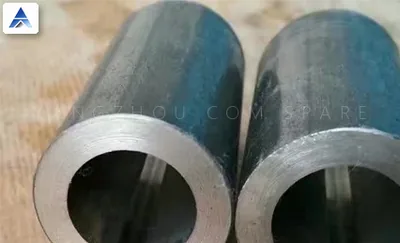 ProductTube Mill Scarfing Tool SystemInternal and external bead removed flush.View specifications →
 ProductTube Mill Spare PartsImpeders, knives, blades and guide rolls.View specifications →
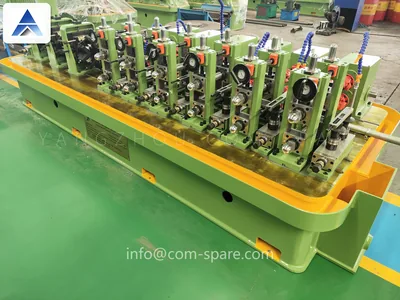 ProductAutopacking MachineCount, stack and strap finished tubes.View specifications →
Need this checked on your own mill?
Send tube OD, wall thickness and the symptom. We reply within one working day.

