
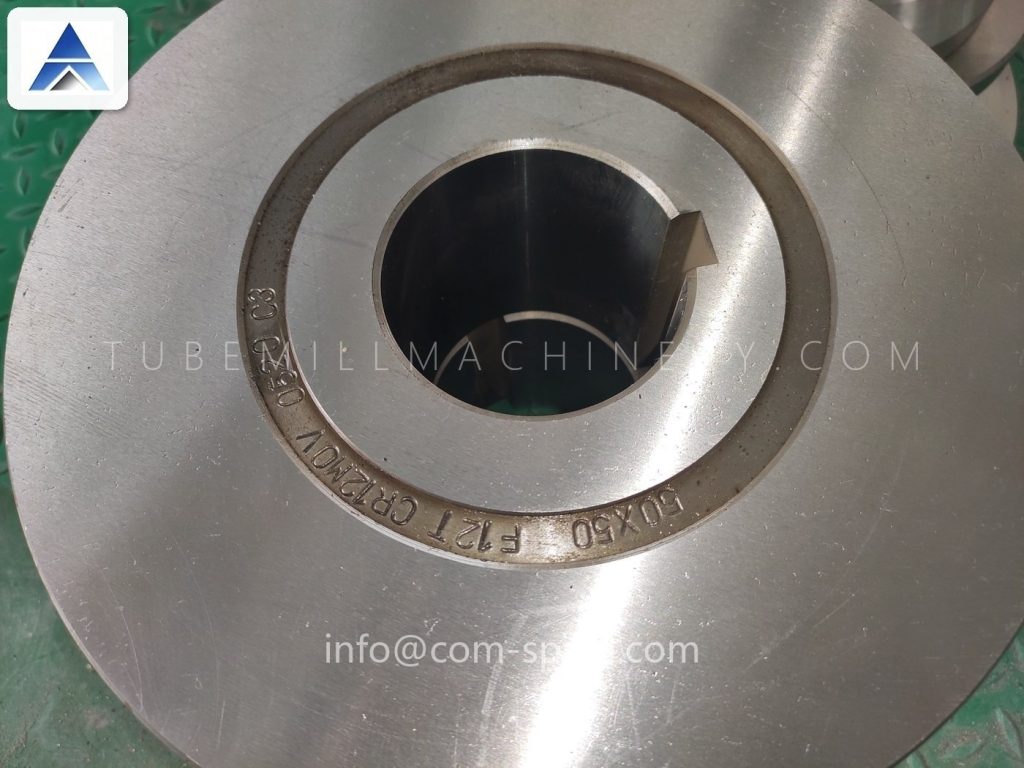
Forming rolls for the larger pipe mills. Bigger diameter, bigger load, and a different problem from tube mill forming: the section is deeper and the wear is concentrated on the shoulder.
Why it matters on the line
- Sized for pipe mill stands, where the section is deeper and the roll load is higher than on a tube mill
- The shoulder of the roll takes the wear on a pipe section, so it is the area we grind and check most carefully
- Supplied matched to your stand diameter and pass line, not as a general purpose roll
- We quote from the mill model and the pass line, because a pipe roll is not interchangeable with a tube roll
What we supply
| Item | What we hold to | Why it matters |
|---|---|---|
| Stand diameter | As your pass line drawing | The roll has to fit the stand and the gearbox |
| Hardness | HRC 58–62 | Pipe forming loads are heavier |
| Shoulder profile | Ground and checked against the drawing | Where the wear concentrates on a pipe section |
| Supply basis | Mill model and pass line | Pipe rolls are not interchangeable with tube rolls |
Every item is machined in our own workshop and marked before it is packed, so it goes back to the stand it came from. If you send us a drawing or a sample we work to that; if you are not sure what you need, send us the mill model and the pass line and we will tell you.
Technical notes
Pipe mill forming is a different problem from tube mill forming: the section is larger, the strip is thicker and the load per stand is much higher. A roll that is correct for a small tube stand will deflect under a heavy pipe load, and the resulting shape error appears as a flat spot or a shoulder mark rather than as simple wear. We size the shoulder profile and the hardness against the wall thickness you actually run, and we check the roll against the stand drawing before machining because the shaft and housing geometry on pipe mills varies widely between makes. If you are running both round and square sections on the same mill, tell us — the shoulder clearance has to suit both.
Frequently asked questions
Why do large pipe forming rolls mark the tube shoulder?
Deflection under load or a shoulder radius that is too tight for the wall thickness. Both show as a mark at the same point on every tube rather than random scuffing.
Can one set of forming rolls cover round and square sections?
Sometimes, where the pass line allows it. The shoulder clearance has to suit both sections, so we check this against your drawing before quoting rather than promising it.
Related products
Tube mill rolls · Tube mill roll set · Tube mill roll design · ERW tube mill line
Send us the drawing or the sample
A drawing, a photo with a ruler in frame, or the mill model is enough for us to quote and to tell you honestly whether the item should be reground or replaced.
Need roll tooling, a flying cold saw, or a complete tube mill line?