
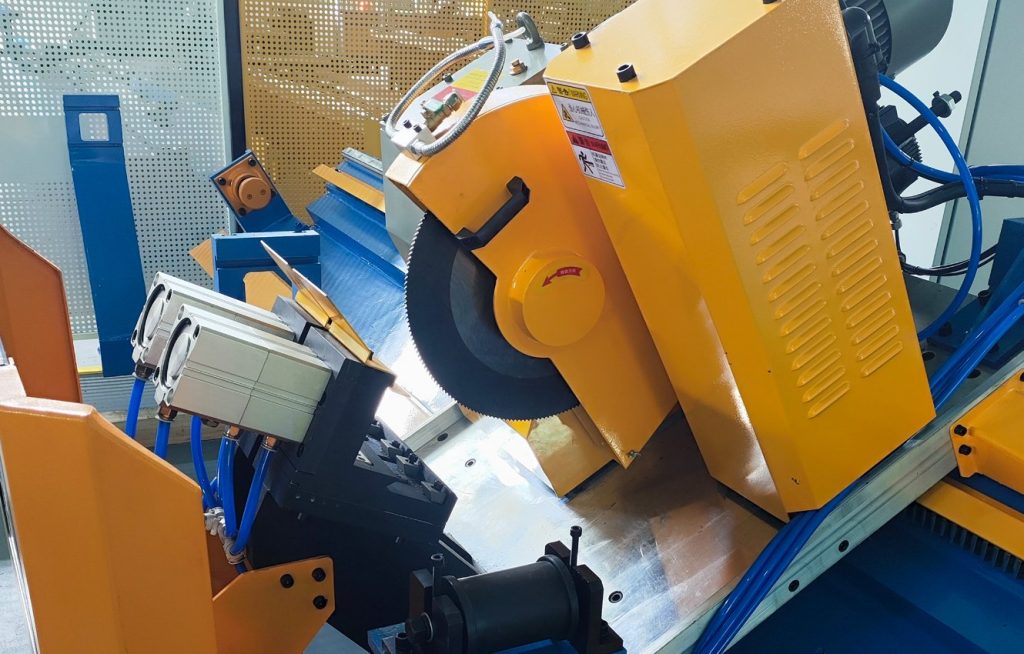
Circular saw blades for flying cold saw machines. In an ERW / HF tube mill, the flying cold saw is the station that decides cut-length accuracy and end-face quality. The blade on that machine is the consumable that actually makes the cut — a worn or wrong-grade blade means burrs, out-of-square ends, noisy cutting and unplanned downtime. This page covers the two blade families, the two tooth forms, and the three details we need to match a blade to your line.
HSS blades on a flying cold saw
HSS (High-Speed Steel) blades are the standard choice for carbon steel tube in thin to medium walls. Running at low speed with coolant, they leave a clean, burr-free end face with no heat-affected zone. Their key advantage is maintainability: the teeth can be re-ground several times, keeping cost per cut low over a long run.

TCT blades on a flying cold saw
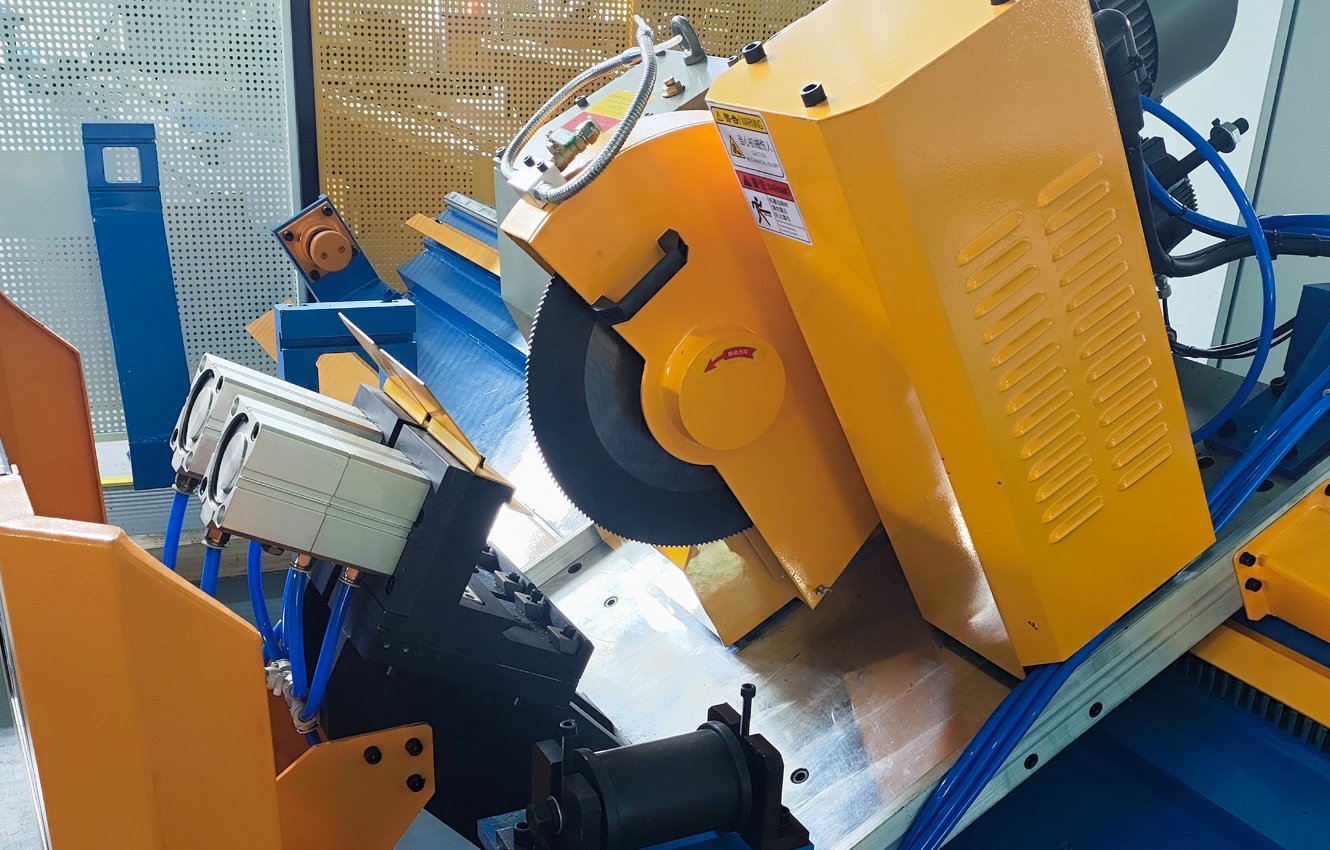
TCT (Tungsten Carbide Tipped) blades carry carbide teeth brazed onto a steel body. The carbide edge holds its hardness far longer than HSS under heat and abrasion, which makes TCT the right answer for large-diameter pipe, heavy wall thickness, high-strength steel and other difficult-to-cut grades.

Two blade families — and when to use each
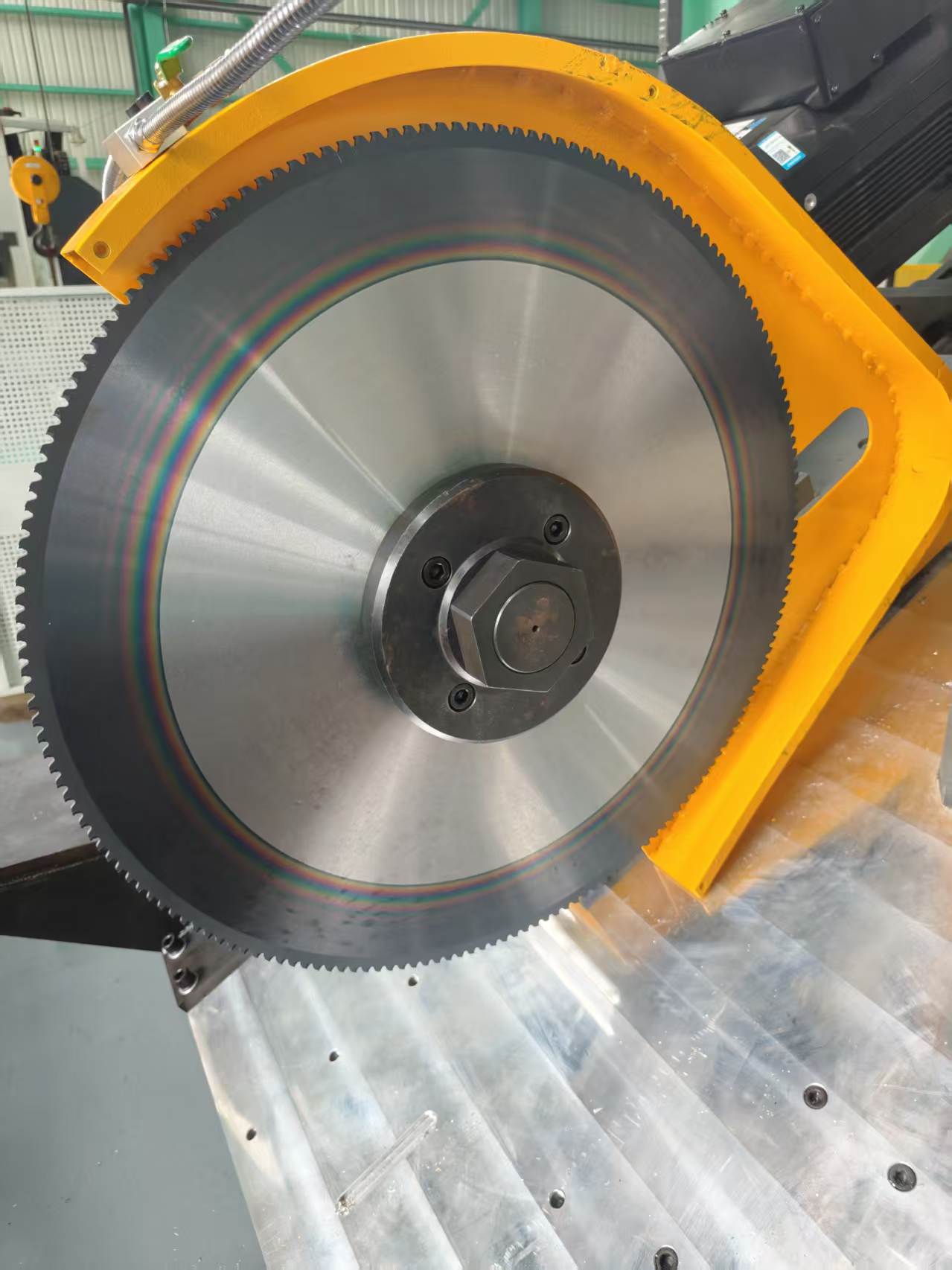
Both families do the same job; they differ in cutting edge, the jobs they suit, and how they are maintained. Choosing between them is a production decision, not a catalog detail.
| Item | HSS blade | TCT blade |
|---|---|---|
| Cutting edge | High-speed steel | Tungsten carbide tips |
| Typical job | Carbon steel tube, thin to medium wall | Large size, thick wall, high-strength steel |
| Re-sharpening | Can be re-ground several times | Normally replaced or re-tipped |
| Cost per cut | Lower in long-run thin wall | Lower in heavy-duty cutting |
Blades are supplied to fit the flying cold saw units built in our own workshop. For non-COMSCO saws, send the saw model and a blade drawing or sample and we will confirm the size, bore and tooth form we can supply.
Tooth forms: BW and BR
The tooth form decides how the chip is broken and cleared, and it matters as much as the blade grade. For tube-cutting saws, two forms cover the great majority of production: BW for general pipe cutting and BR for fully automatic machines.
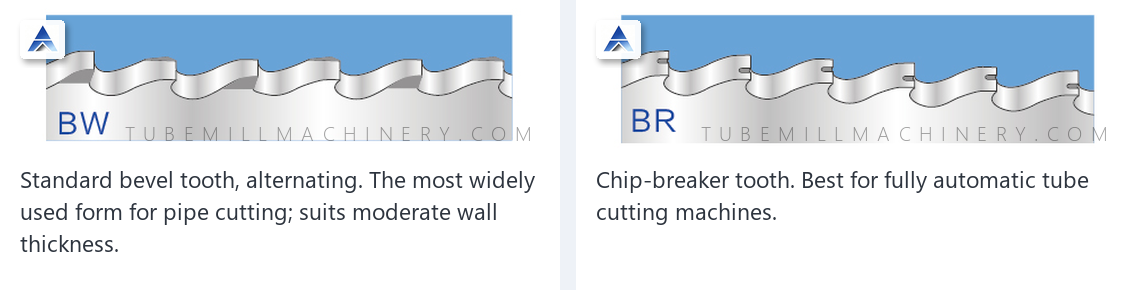
- BW — standard bevel, alternating. The most widely used form for pipe cutting. Teeth are alternately bevelled, splitting the chip in two for clean evacuation; suited to moderate wall thickness.
- BR — chip-breaker. The preferred form for fully automatic tube cutting machines. The breaker groove divides the chip, improves the cut face and extends tool life in automatic flying saws.
Re-sharpening and blade life
HSS blades are not single-use: the teeth can be re-ground several times on a dedicated blade grinding machine, which is what keeps cost per cut low in long-run thin-wall production. TCT blades are normally replaced or professionally re-tipped rather than ground in-house. Choosing the correct grade and tooth form for your tube is what gives a stable cut face and predictable blade life.
Three things we need to match a blade
Send us three details and we will confirm the right blade grade and tooth form for your line:
- The material of the tube you are cutting on the line. Carbon steel, alloy or high-strength grade — this decides HSS or TCT.
- Tube outside diameter and wall thickness. OD and wall decide the blade diameter, tooth pitch and tooth form.
- The blade specification: OD × ID × thickness × pin hole. Send the size you are using now, or the drawing / sample, and we will confirm what we can supply.
We can also propose a re-grinding cycle for HSS blades to lower cost per ton.
Need help choosing a blade?
Send the tube material, the tube OD & wall thickness, and your current blade size (OD × ID × T × pin hole). Our engineers will confirm the grade and tooth form for your flying saw.
Frequently asked questions
Can HSS blades be re-sharpened?
Yes. HSS blades can be re-ground several times on a dedicated blade grinding machine, which is the main reason they stay economical in long-run thin-wall production.
When should I switch from HSS to TCT?
When you move to large diameters, heavy wall thickness or high-strength steel — applications where the carbide edge keeps its hardness and outlasts HSS.
Which tooth form do I need?
BW for most tube cutting, BR for fully automatic flying saws. Send your tube size and wall thickness and we will confirm the right form for your line.
Do you supply blades for non-COMSCO saws?
Send your saw model and blade drawing / sample and we will confirm the size, bore and tooth form we can supply.
Related products
Cut-off stationFlying Cold SawHigh-speed, milling and double-blade saws for ERW tube lines, built in our own workshop.See flying cold saws →
 Coil end handlingShearing & Welding MachineCuts the strip and welds the butt joint before it reaches your forming stands.See the shear & welder →
 Roll toolingTube Mill RollsForming, fin and sizing passes, ground and hardened to your flower pattern.See roll tooling →
Need roll tooling, a flying cold saw, or a complete tube mill line?