
Part of our tube mill roll design guide.
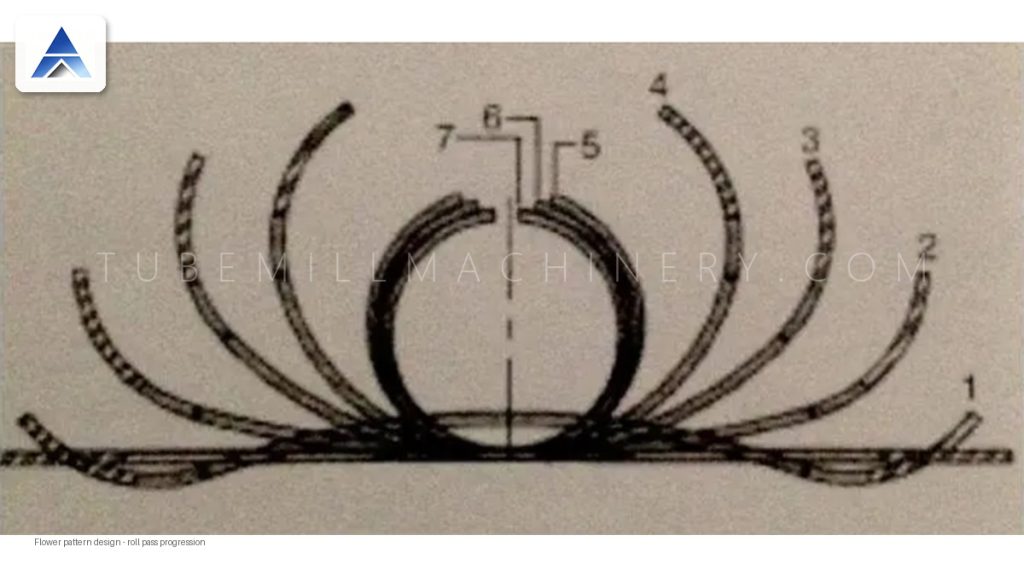
A customer sends a drawing for a 60×40×2.0 mm rectangular tube and asks a simple question: “how many passes do we need?” It sounds like a number question. It is actually a question about the whole flower — how far you bend the strip at each stand, where the edge strain builds up, and whether the two edges arrive square and parallel at the welder. Get that sequence right and the mill runs quietly. Get it wrong and no amount of roll regrinding will fix the edge wave.
This note is the practical version of that conversation: what a roll pass design actually decides, how we read a flower pattern, and the three failure modes we see most often when a new set is commissioned. It is written for mill owners and purchasing engineers, not for CAD operators. For the drawing-level detail see our flower pattern design page.
Pass design and flower pattern are not the same thing
The two terms get used interchangeably, but they are different layers of the same job.
- Pass design is the set of decisions: number of stands, how much each bend line moves per stand, the order in which the section closes, where overbend and sizing happen, and how side rolls and guides support the strip.
- The flower pattern is the picture of those decisions — the stack of cross-sections from flat strip to finished tube, laid over each other like petals. It is the visual language the whole tooling package is built around.
Why the distinction matters: a flower can look elegant on paper and still be un-buildable, because the decisions behind it ignore stand spacing, roll diameter or the strip’s real behaviour. We always validate the decision layer first, then draw.
The design sequence we follow
- Fix the finished section. OD or profile, wall thickness, material grade and yield strength, tolerance and applicable standard. The thickness-to-diameter ratio matters here: thick-wall and high-yield grades need gentler forming and more robust tooling than thin-wall tube.
- Estimate the strip width. For round tube the neutral-axis circumference, approximately π × (OD − t), is a starting point — not an answer. Bend allowance, edge condition and weld upset allowance all move the final number, and we confirm it by trial. Our strip width calculation page explains the neutral-axis shift that makes a flat formula insufficient.
- Build the flower. Distribute the bend across stands so no single pass takes a sudden jump. The common industry starting points — roughly 95–97° on the first pass and 320–325° before fin pass for round tube — are rules of thumb, not standards. We treat them as a first guess and adjust by material and profile.
- Choose the forming route. Edge forming, centre-break / W forming, or flexible forming (FFX / direct forming). The route is a commercial decision as much as a technical one: it fixes how many roll sets you buy and how long a size changeover takes.
- Design fin pass, squeeze and sizing. Fin pass delivers two parallel, correctly positioned edges to the welder. Errors here show up directly as cold welds, offset seams or excess bead. Sizing and the Turk’s head then set final diameter, roundness and straightness.
- Validate. Experience rules first, then forming simulation where the profile is difficult, then a physical tryout. A flower that has never been tried is a hypothesis.
Three failure modes we see at commissioning
| Symptom on the mill | Usual cause in the pass design | Where to look first |
|---|---|---|
| Edge wave in early stands | Bend increment jumps too fast; edge strain not distributed | Passes 1–4 of the flower |
| Seam offset or cold weld | Edges not parallel at fin pass; centring drift | Fin pass geometry and guide alignment |
| Ovality or springback after sizing | Too little calibration; material yield misunderstood | Sizing stands and Turk’s head |
Notice that none of these are fixed by changing roll material alone. Material choice — Cr12MoV, D2/SKD11, Cr12 or H13 depending on the job — affects wear life and surface finish, but it cannot repair a badly distributed flower. We cover that separately in our notes on roll material and heat treatment.
What to send us for a pass design review
- The finished section drawing — profile, wall thickness, radii and tolerance.
- Material grade and yield strength, or the standard the tube must meet.
- Your mill’s stand count, stand spacing and available roll diameter.
- The size range you want one set to cover, and how often you change size.
With those four items we can tell you whether the profile fits your current line, how many stands it needs, and where the risk sits before any steel is cut. Where a customer wants a complete tooling package rather than a single set, we build the complete pass line set as one matched system. Our rolls and tooling are made in our own workshop. Send a drawing here.
Frequently asked questions
How many stands does a square or rectangular tube need?
It depends on section size, wall thickness, material and the forming route. Simple sections often sit in the teens of stands; larger or asymmetric profiles need more. Stand count is a starting estimate from the flower, not a fixed number.
Can one roll set cover several tube sizes?
Within a limited range, yes — especially with flexible or adjustable forming. Beyond that range you trade changeover speed against forming quality. Send your size list and we will tell you where the sensible break points are.
Why does the first pass use such a large roll radius?
Because the strip’s neutral-axis circumference is much larger before bending. Early passes work with a long developed length and a small bend angle, so the radius is large; it tightens progressively as the section closes.
Do you design tooling for mills that are not COMSCO’s?
Yes. Give us the stand count, spacing and roll dimensions of your existing line and we will design a set that fits it. The pass design is built around your mill, not ours.
Can you work from a sample tube instead of a drawing?
Yes. A sample plus the material grade is enough to start the review. We will confirm dimensions and propose the section drawing before quoting tooling.
Related reading
Flower pattern design · Strip width calculation · Roll material and heat treatment
Keep reading
Tube Mill Roll Changeover: Where the Hours Actually Go
By Deffy Su, in this trade since 2011 · COMSCO engineering notes · Last reviewed November 2026 Part of our…

Reading Roll Wear: Resharpen, Recoat or Replace?
Every roll set reaches a point where the decision is no longer technical but economic. Four measurements tell you whether…
Roll Material and Heat Treatment: D2, Cr12MoV, H13 and What Actually Lasts
Two roll sets can look identical and last very differently. The difference is in the steel grade, the heat treatment…
Tube Mill Roll Design: From Flower Pattern to the First Good Tube
Roll design is not a drawing exercise. It is a sequence of decisions about strip width, bend distribution and edge…
Related Products
Machines that do the job described above — quoted station by station.
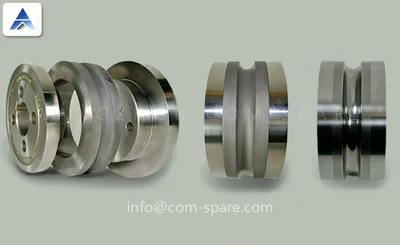 ProductTube Mill Rolls & Roll ToolingPass design, machining and vacuum hardening in-house.View specifications →
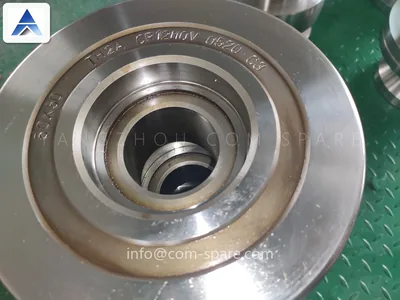 ProductTube Mill RollsFinished passes, ground after hardening.View specifications →
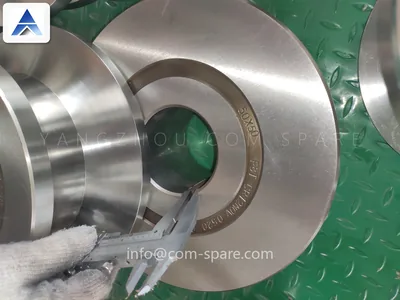 ProductTube Mill MouldForming and sizing moulds to your flower pattern.View specifications →
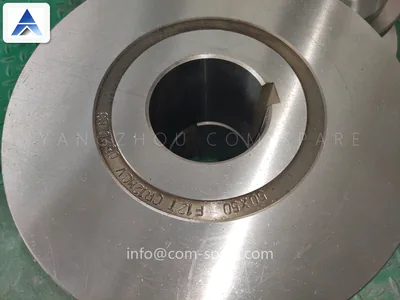 ProductTube Mill Roll SetA complete pass line, numbered and pre-set.View specifications →
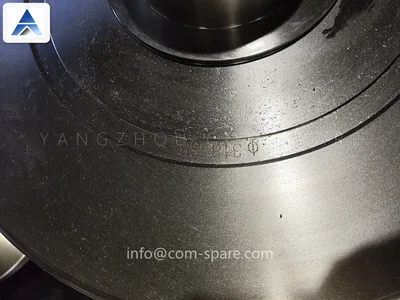 ProductTube Mill Roll DesignFrom flower pattern to finished pass drawing.View specifications →
Need this checked on your own mill?
Send tube OD, wall thickness and the symptom. We reply within one working day.