
Part of our flying cold saw guide.
“Flying saw or cold saw?” is rarely a pure price question. We have seen the same decision go two different ways at two mills making the same diameter — because one sold structural tube where a blue heat mark on the end was acceptable, and the other shipped precision tube to an automotive customer who measured the cut face. The right answer follows the tube specification, not the sales brochure.
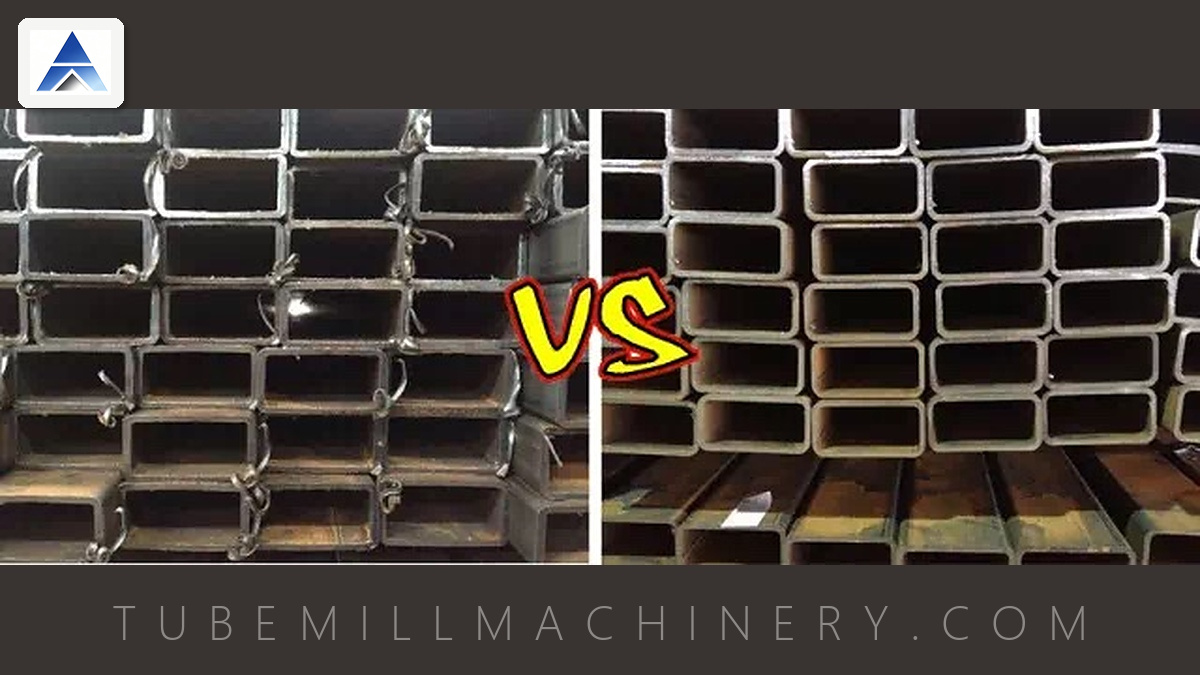
There are two machines under discussion, and it helps to name them precisely. A conventional flying saw (often a friction or hot saw) spins a disc fast enough that friction heats the steel to a soft state and the blade pushes through. A flying cold saw cuts at low speed with high torque and a carbide-tipped blade, milling through the wall with a servo-synchronised carriage so the tube keeps moving. For the cost-of-ownership angle on that same comparison, see our separate note on flying cold saw vs friction saw. This article is the selection guide: which spec points to which machine.
The difference that decides everything: heat
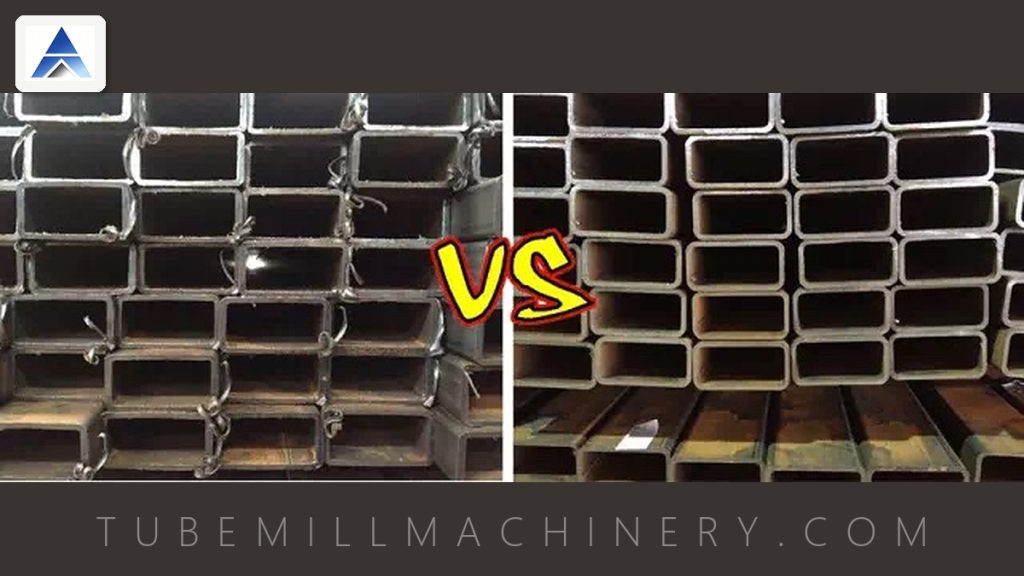
A friction blade runs at very high peripheral speed. The contact zone reaches a temperature where the steel softens, and the blade displaces the metal out of the cut. That gives a fast, cheap cut — with a heat-affected zone, a blue-purple end face, hanging burrs and some risk of ovalising thin wall.
A cold saw does the opposite. The carbide teeth remove material as chips at controlled speed and feed; most of the heat leaves with the chip. The end face comes out square and clean, with no heat tint and virtually no burr, so the tube can often go straight to packing or the next process. The trade-off is a higher machine cost and a slightly longer cut cycle.
| Decision factor | Flying (friction) saw | Flying cold saw |
|---|---|---|
| Cut principle | High-speed friction, hot shear | Low-speed, high-torque carbide milling |
| End face | Heat tint, burr, may need deburring | Square, clean, normally no secondary finish |
| Typical length tolerance | around ±3 mm | ±1 mm or better with encoder + servo clamp |
| Cut cycle | Faster single cut | Slightly slower single cut, no downstream deburring |
| Blade life | Shorter; frequent changes | Longer; re-grindable carbide edge |
| Noise and sparks | High; sparks and smoke | Low; dry or minimal-quantity lubrication |
| Best fit | Structural tube, scaffolding, general line | Precision, automotive, stainless, export-grade tube |
Figures are typical industry ranges, not guarantees. Actual tolerance depends on encoder resolution, clamp rigidity and carriage synchronisation — see our note on cut length tolerance.
Four real scenarios and what we recommend
- Structural tube, carbon steel, wall above 2 mm, customer accepts a heat-tinted end. A flying friction saw is the economical choice. It keeps line speed high and the machine cost low. This is the volume-for-price end of the market.
- Precision tube, tight length tolerance, end face goes into a welding or bending cell. Cold saw. The clean, square face removes the deburring station and the rework risk downstream, which is where the real saving sits.
- Stainless or alloy grades. Cold saw, virtually without exception. Friction heating work-hardens these grades and shortens blade life sharply. If you run both carbon and stainless, a cold saw covering the whole range is usually simpler than two machines.
- Wide size range on one line, frequent changeovers. Look at the drive and clamp first: a belt-driven high-speed saw suits lighter, faster work, while a rack-driven machine holds rigidity on larger diameters and heavier walls. Our high-speed flying cold saw covers Ø16–140 mm, and the rack-driven range goes to Ø273 mm with -P / -H clamping. The MR76 (Ø32–89 mm, up to 90 m/min) and MR127 (Ø63–140 mm, up to 60 m/min) are the two we are asked about most.
A five-question decision check
- What is the end use — structural, fluid, automotive, or pressure?
- What length tolerance does the customer actually measure?
- Which grades will the line run in twelve months, not just today?
- Is there a deburring step after the saw, and what does it cost in labour and floor space?
- How often do you change diameter, and how fast must that change be?
If your answers to 1 and 2 are “precision” and “±1 mm”, the discussion is effectively over. If they are “structural” and “±3 mm is fine”, you can save capital with a friction saw and spend the money elsewhere on the line.
One thing the quotation will not tell you
Both machines are sold on cut speed. Neither quotation shows the deburring operator, the rework on deformed ends, or the blade changes per shift. Ask for a cost per accepted cut — blade consumption plus downstream labour plus scrap — and the comparison changes. Our saws and the blades matched to them are built in our own workshop, so we can quote the machine, the blade and the regrind path together. Send your tube spec here and we will tell you which machine fits, without pushing the more expensive one by default.
Frequently asked questions
Is a flying cold saw always slower than a friction saw?
The single cut cycle is usually a little longer. But when you count the deburring and end-facing that a friction cut often needs, total line throughput can be the same or better.
Can a cold saw cut carbon steel as fast as a friction saw?
Not on the single cut. The advantage of the cold saw is cut quality and consistency across grades, not raw blade speed. For high-volume structural tube with no finish requirement, friction remains competitive.
Do I need a different blade for stainless steel?
Yes in practice. Carbide-tipped blades are the normal choice for stainless and alloy grades. We match the blade to your material and can advise on tooth form and regrind intervals.
What length tolerance can a flying cold saw hold?
±1 mm or better is typical when the encoder, clamp and carriage are properly matched and maintained. It is a system result, not a property of the blade alone.
Can you supply a saw for a line that is not COMSCO’s?
Yes. Send your tube range, line speed, drive layout and the tolerance you need, and we will propose a saw that fits the existing line.
Related reading
Flying cold saw vs friction saw: real cost comparison · TCT vs HSS saw blade · Saw blade life on a flying cold saw
Keep reading
TCT vs HSS Saw Blade for Tube Mills: How to Choose
By Deffy Su, in this trade since 2011 · COMSCO engineering notes · Last reviewed November 2026 Part of our…
Cut Length Tolerance on a Flying Cold Saw: Encoder, Clamp and Carriage
Lengths that wander by a few millimetres are rarely a blade problem. Three subsystems decide cut length — measurement, clamping…
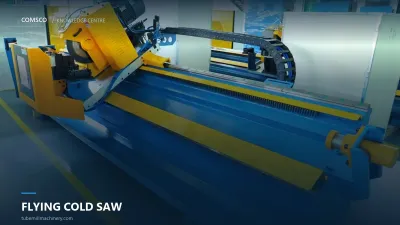
Saw Blade Life on a Flying Cold Saw: Seven Variables You Can Control
If blade consumption is eating your margin, the answer is rarely a different blade brand. Seven variables decide how many…
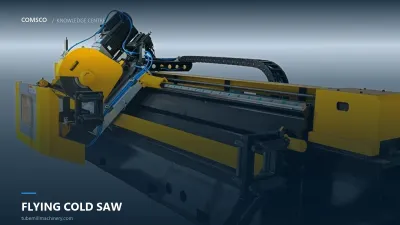
Flying Cold Saw vs Friction Saw: What the Cut Face Really Costs
The cheap cut-off is rarely the cheap decision. A comparison of cold saw and friction saw on cut quality, secondary…
Related Products
Machines that do the job described above — quoted station by station.
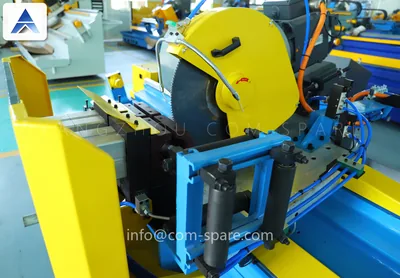 ProductFlying Cold SawBurr-free cut ends at line speed, no heat-affected zone.View specifications →
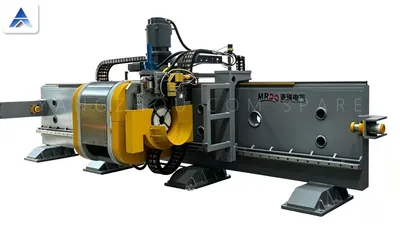 ProductFlying Cold Saw — Ø16 – Ø273 mm, Rack Drive, -P / -H ClampCarriage, clamp and encoder in one frame.View specifications →
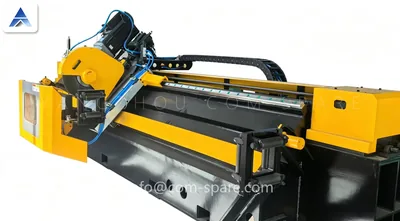 ProductHigh-Speed Flying Cold Saw — Ø16 – Ø140 mm, Timing Belt DriveShort cycle times for thin-wall, high-volume tube.View specifications →
 ProductMilling Type Flying Cut-Off — Ø89 – Ø508 mm, Twin BladeOrbital milling for large OD and heavy wall.View specifications →
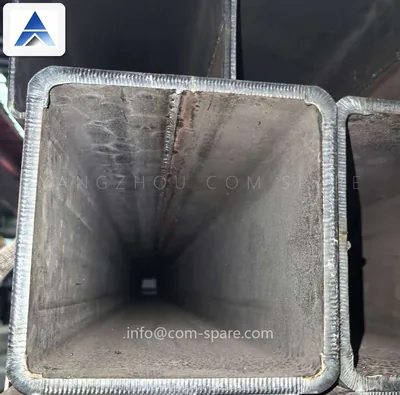 ProductLaser Flying Saw — Ø16 – Ø630 mm, No Blade, No BurrNo blade, no burr, no blade consumable.View specifications →
Need this checked on your own mill?
Send tube OD, wall thickness and the symptom. We reply within one working day.